
Evolution of Human-Computer Interaction and where spatial computing is taking us to.
To the era of Augmented World
Evolution of Human-Computer Interaction and where spatial computing is taking us to
To the era of Augmented World.
Computers are considered to be one of the important inventions that changed human history along with other inventions like fire. It’s not the fire, but the control of fire by early humans was a turning point. Similarly, innovation on how we interact with computers played a vital role in its evolution.

Photo by Stephan Henning on Unsplash
Human-Computer Interaction has been a buzzing field right from its beginning from the days of command-line interface (CLI) to the current natural user interface (NUI). Though we call it Human-Computer Interaction, Computers have been put first ignoring human abilities for a long time. When we say Human-Computer Interaction, there is a flow of information between the human and the computer, and it is defined as the loop of Interaction.
This loop is currently maintained with the help of a keyboard or direct manipulation devices like mouse, touch screens, stylus, etc. Although the direct manipulation devices offer us a natural representation of actions, it has its limitations. These interactions are performed with the help of intermediary devices which doesn’t let human abilities to be used at its full potential. The current interactions are more catered towards the visual and auditory senses.
The future where we are heading to with the rise in Ubiquitous Computing (Pervasive Computing), Artificial Intelligence, Ambient Intelligence, and IoT devices are blurring the lines between us humans and technology. To interact with these machines to its full potential, the Interaction needs to be implicit and as natural as possible, which requires enhancing or augmenting our senses. The hardware needs to fade into the background and become a part of the environment, leaving only the software for users to interact with, so we interact with these machines as naturally as possible.
One such technology that helps us to partner with these machines is Spatial Computing, in which the device retains and manipulates real objects and spaces around us as a medium to interact with technology. Using the 3D space which we humans are familiar with helps us to utilize the underused capabilities of our senses in understanding the complex information in the world.
Spatial Computing will make the computer’s user interface a seamless part of the three-dimensional world in which we live, work, and play.
In any interaction, generally, there is a way to perceive the information and a way to interact with it. In Spatial Computing, it is a display technology like AR, VR primarily, and spatial sounds. For interactions, voice control, eye tracking, hand/body tracking(gestures), and haptics are used.
A human with the potential to understand complex information and a machine that could process complex data would be the better partners of the future.
Where has spatial Computing taken us so far?
Spatial computing is broadly synonymous with extended reality (XR).
XR is an umbrella term that includes any technology that helps us to merge the physical and digital worlds. It blends the worlds by digitally enhancing the human senses.
Extended reality is either used to provide more information about our actual environment to enhance our senses, or else to create completely artificial experiences.
Enhanced Senses
XR is helping us to look beyond our abilities, it’s helping firefighters and first responders to see through smoke and darkness. It is also guiding people with vision impairment to better navigate through the world. Solutions are also utilizing other senses to augment vision and vice versa.

Credit: https://www.qwake.tech/
Credit:https://esighteyewear.com/
Increased Efficiency
Spatial Computing has increased efficiency in multiple fields of work. Several studies have reported a significant increase in motivation, attention, confidence, and satisfaction of learners using this spatial technology when compared to traditional ones. XR solutions are also being used from factory floors to health care units to augment the right information to assist staff in making their work efficient and safe.
Credit: https://www.accuvein.com/
3D Visualization
60% of the human brain is involved in processing what we see, and most of the products we live in the 3D space in the real world, but we were limited with the 2D rectangular screens for designing, prototyping, and developing these products. Spatial Computing has opened immense opportunities in envisioning outcomes, prototyping them with the least resources and but experiencing them in their genuine sense in the real world. Not just that, they also let consumers experience these products in the real world before making a purchase. So 3D visualization has made an impact right from how a product is thought to how it is being consumed.
Credit: Microsoft
Telepresence
Telepresence is one of the rapidly growing use cases in spatial Computing. With COVID and remote working being the new standard, multiple solutions are emerging to help in remote collaboration from expert guidance in the service industry, virtual collaboration rooms, virtual conferences, product launches, and virtual tours in real estate agencies. Not just for work, even if the job can be done from home, spending time at the same place day in, day out will be challenging. Entertainment, personal lifestyles like shopping, traveling will also be envisioned using spatial computing technologies.
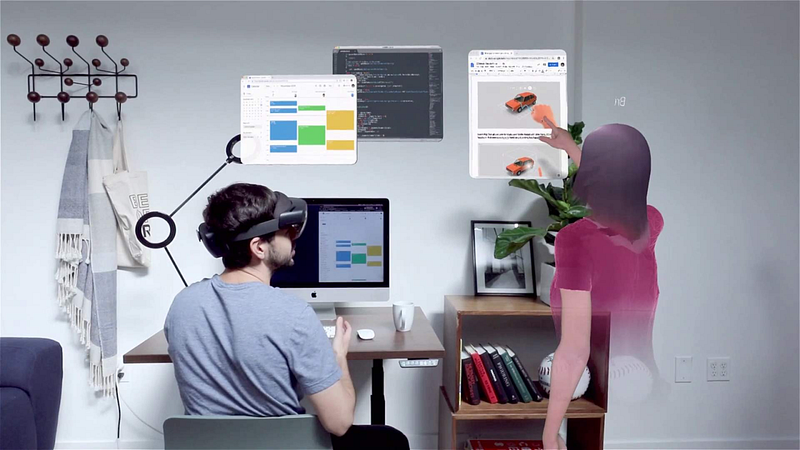
Credit: https://spatial.io/
The era of Augmented World
Spatial Computing is the natural evolution of interactions for the era of invisible computers, just not COVID accelerating its needs now. Reduction of cost and improvement in 3D pipelines, new tools for developers and designers to co-create rapidly test and deploy solutions, hardware capabilities, display technologies, and the introduction of 5G network connectivity will further accelerate the adoption. Spatial Computing will become ubiquitous in the new normal.