From Search Bars to Action Engines: The Evolution of Computing
We are witnessing a monumental shift in how we interact with technology. It’s no longer about where you click, but what you want to…
From Search Bars to Action Engines: The Evolution of Computing
We are witnessing a monumental shift in how we interact with technology. It’s no longer about where you click, but what you want to achieve.
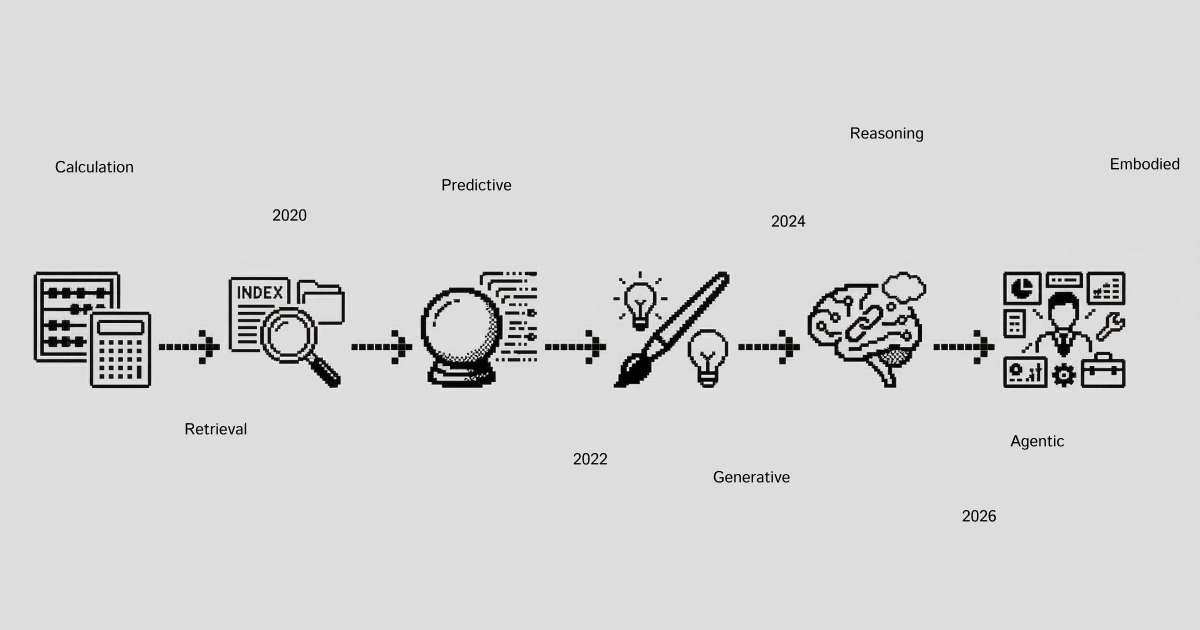
For decades, we viewed computers as supercharged filing cabinets — tools that helped us store, organise, and find information. Today, we are standing on the precipice of a new era in which computers are not merely retrieval systems but active collaborators capable of reasoning, planning, and executing complex workflows.
This is the shift from the Retrieval Era to the Agentic Era. Here is how we got here.
1. The Retrieval Era: The Age of the Librarian (Pre-2020)
Remember the primary function of early personal computing and the first wave of the internet? It was all about accessibility. If you needed an answer, you had to find the right document.
- Mechanism: Keyword indexing, database queries, and SQL.
- The Paradigm: “I have a query; find me the static document that contains the answer.”
- The Vibe: The computer as a digital library. Great at providing data, but requiring the human to do all the context-building and synthesis.
2. The Predictive Era: The Age of the Oracle (2010s — 2022)
Before computing learned to create, it learned to anticipate. Recommendation engines changed our relationship with data by predicting what we might want next, creating a personalised experience.
- Mechanism: Machine Learning algorithms analysing patterns (e.g., matrix factorisation).
- The Paradigm: “Based on your past behaviour, you will probably like this.”
- The Vibe: The computer as a proactive guide. This was the first major step away from passive retrieval.
3. The Generative Era: The Age of the Artist (2022–2024)
This is the phase we are just beginning to stabilise in. Generative AI (powered by Large Language Models) broke the requirement for static documents. Instead of finding data, AI began creating original synthesis.
- Mechanism: Probabilistic token prediction.
- The Paradigm: “I have a concept; synthesise an explanation, draft, or visual for me.”
- The Vibe: The computer as an infinitely creative assistant. The focus shifted from location to creation.
4. The Reasoning Era: The Age of the Scholar (2024 — Present)
We are currently transitioning into this era. As powerful as Generative AI is, its major flaw has been a lack of “System 2” deep thinking, leading to confident hallucinations. The Reasoning Era solves this by introducing logical verification.
- Mechanism: Chain-of-Thought (CoT) processes and internal logic self-correction.
- The Paradigm: “I have a multi-step problem; think through the constraints and verify the logical consistency of the solution.”
- The Vibe: The computer as a critical thinker. AI is no longer just predicting the next word; it’s evaluating its own work before outputting the final result.
5. The Agentic Era: The Age of the Manager (2025 and Beyond)
This is the culmination — the real-world integration that brings all prior stages together.
Agentic systems take the reasoning and creative abilities of previous eras and combine them with Agency: the ability to use external tools, make decisions, and interact with other software autonomously to achieve a higher-level goal.
- Mechanism: AI agents using APIs, software integrations, and long-term memory.
- The Paradigm: “I have a comprehensive goal (e.g., plan and book a complete vacation); create the plan, use the necessary services, execute the transactions, and notify me when it is done.”
- The Vibe: The computer as an Action Engine. This is the final move from AI as a chatbot you talk to, to AI as a workforce you collaborate with.
The New Architecture: An Ecosystem of Agents
This evolution fundamentally changes product design and user experience. We are moving away from monolithic, “all-in-one” platforms and towards an Ecosystem of Specialized Agents.
In this new paradigm, your value as a business (or a product) isn’t just about the data you possess (Retrieval) or the reports you generate (Generative). It’s about how seamlessly you integrate into the Agentic workflows of your users.
The future of technology isn’t just about asking better questions. It’s about designing systems capable of taking the actions that answer them.