
Journey Within: Reading Mahatma Gandhi’s Experiments with Truth.
Mahatma Gandhi’s “My Experiments with Truth,” or Sathya Prayog, is more than just an autobiography; it’s a chronicle of a lifelong quest.
Journey Within: Reading Mahatma Gandhi’s Experiments with Truth.
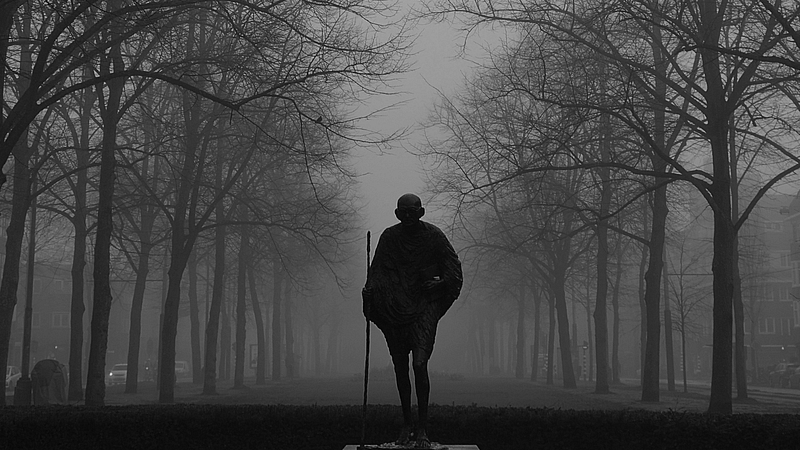
Photo by Greg Schneider on Unsplash
Mahatma Gandhi’s “My Experiments with Truth,” or Sathya Prayog, is more than just an autobiography; it’s a chronicle of a lifelong quest. A quest not for political power, though he undeniably wielded it, but for something far more profound: Truth. Reading this seminal work has been less of a passive activity and more of an active engagement, an experiment in itself. As I delved deeper into Gandhi’s journey, It resonated with the Tamil word Kadavul and its meaning as one of my coaches introduced me.
Let’s first unpack this fascinating word. In Tamil, Kadavul is the word for God. But break it down, as did my coach, and you get “kada vul”. “Kada” signifies a journey, a path, or a movement. “Vul” points inward, towards the self, the inner space. Put them together, “kada vul” paints a picture of travelling within. Think about it: Kadavul, God, as the journey within.
This linguistic insight unlocked a new layer of understanding of Gandhi’s Experiments with Truth. He wasn’t just experimenting with external actions—fasting, nonviolence, civil disobedience—but was fundamentally engaged in a relentless “kada vul,” a journey within himself. His experiments were not just about discovering the truth “out there” but about purifying himself, understanding his flaws and limitations, and ultimately realizing the Truth within.
Gandhi’s autobiography is unflinchingly honest. It describes his struggles, moral dilemmas, and moments of weakness and strength. The author recounts his experiments with diet, brahmacharya (celibacy), and simple living, all in the pursuit of self-purification. He wasn’t aiming for sainthood in the conventional sense but rather for a deeper understanding of his being and its relationship with Truth.
He writes, “What I want to achieve — what I have been striving and pining to achieve these thirty years — is self-realization, to see God face to face, to attain Moksha. I live and move and have my being in pursuit of this goal.” Notice the language: self-realization, to see God face to face. This isn’t about external rituals or dogmatic beliefs. It’s about an internal transformation, a journey into the depths of his soul to encounter the divine.
This resonates so deeply with the “kada Vul” concept. Gandhi’s experiments were his way of navigating the inner landscape, clearing the obstacles of ego, desire, and ignorance to reveal the inherent divinity within. His ashrams were not just communities but laboratories for this internal exploration. His practices of prayer, meditation, and selfless service were the tools for his “kada vul.”
Reading about Gandhi’s relentless pursuit of Truth makes you question your journey—or perhaps the lack thereof. How often do we embark on our own “kada vul” in our busy, external-world-focused lives? How usually do we turn inward to examine our motivations, truths, and relationships with something larger than ourselves?
Gandhi’s life embodied the idea that the path to God, the path to Truth, is not found in grand pronouncements or external displays of piety but in the quiet, persistent exploration of our inner selves. It’s in the daily experiments with honesty, compassion, and self-discipline. It’s in confronting our shadows and striving for self-improvement, not for external validation, but for the inner peace that comes with aligning oneself with Truth.
My reading of Experiments with Truth, viewed through the lens of “kada vul,” has been transformative. It has reminded me that self-realization is not a destination but a journey — a continuous “travelling within.” It’s a call to embark on my experiments with Truth, explore the Kadavul that resides within, and strive for a life that aligns with that inner divinity.
Gandhi’s legacy isn’t just about political freedom; it’s about the enduring relevance of the inner journey for everyone. He showed us that the most profound experiments are not conducted in laboratories but within the human mind. Perhaps the most potent form of God is not found on a distant mountaintop but discovered in the quiet depths of our being through the courageous and continuous act of “kada vul.”