
Navigating Decision-Making in Product Strategy
Insights from “Decisive”
Navigating Decision-Making in Product Strategy
Insights from “Decisive”
In product building and in life in general we constantly grapple with complex decision-making scenarios. The landscape of product development is fraught with uncertainty, rapidly evolving market trends, and a plethora of user needs and expectations. In this dynamic environment, making the right decisions is not just crucial but often daunting. This is where “Decisive: How to Make Better Choices in Life and Work” by Chip and Dan Heath becomes an indispensable guide.
Understanding human psychology is as critical as understanding technology. Every decision we make, from feature prioritization to market positioning, hinges on our understanding of user behavior and cognitive biases. “Decisive” offers a profound look into how we can navigate these biases and make better choices.
The WRAP Process: A Framework for Strategic Decision-Making
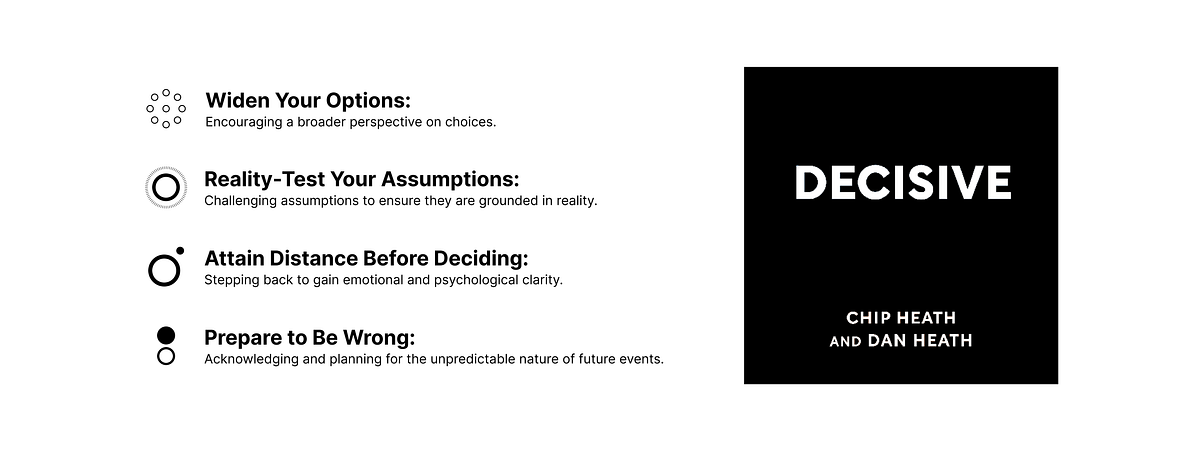
The Heaths present the WRAP process, a four-step framework,
1. Widen Your Options
The first step in improving decision-making is to widen your options. The Heaths argue that many decisions fail because they are framed too narrowly, often boiling down to a binary choice: “Should I do this or not?” Instead, they suggest considering a range of alternatives.
This can be achieved through techniques like:
- Multitracking: Exploring multiple options simultaneously.
- Vanishing Options Test: Imagining that your current options are no longer available to force thinking about alternatives.
In product development, we often get tunnel vision, focusing on a single feature or solution. We can overcome this by applying widen our perspective and consider multiple options. This aligns with the concept of design thinking, where exploring a range of possibilities leads to more innovative and user-centric solutions.
2. Reality-Test Your Assumptions
The second step involves reality-testing your assumptions. The authors highlight the importance of seeking disconfirming evidence and considering the opposite of what you initially believe.
Techniques include:
- Consider the Opposite: Actively looking for evidence against your beliefs or assumptions.
- Zoom Out, Zoom In: Seeking outside perspectives (Zoom Out) and examining on-the-ground realities (Zoom In).
- Ooching: Conducting small experiments to test assumptions or hypotheses.
As product creators, we’re prone to biases and assumptions about our users and markets. We can challenge these assumptions by seeking disconfirming evidence. This step resonates deeply with the iterative testing and validation processes in Agile methodologies.
3. Attain Distance Before Deciding
The third step is about attaining emotional and psychological distance before making a decision. This helps in reducing short-term emotions and biases.
Strategies include:
- 10/10/10 Analysis: Considering how you will feel about the decision 10 minutes, 10 months, and 10 years from now.
- Honoring Your Core Priorities: Identifying and staying true to your long-term objectives and values.
Decisions in product strategy can be clouded by emotional biases or the allure of the latest technology trends. To attain distance helps in evaluating decisions against long-term product vision and user needs, rather than short-term gains or personal biases.
4. Prepare to Be Wrong
The final step involves preparing for a range of outcomes, acknowledginvariousure events are often unpredictable.
This includes:
- Setting Tripwires: Creating alerts or triggers to prompt you to reconsider your decision.
- Bookending the Future: Anticipating the best-case, worst-case, and most likely scenarios.
In the fast-paced tech industry, the only constant is change. To prepare for various outcomes is a reminder to build flexibility into our product roadmaps and to be ready to pivot when necessary.
Application in Product Building
Applying the WRAP process has profound implications in product strategy:
In Feature Prioritization:
How do we explore diverse user needs and not just focus on the most vocal customer feedback.
In Market Analysis:
Challenging market assumptions with real data and varied perspectives.
In Roadmap Planning:
Balancing short-term achievements with long-term strategic goals.
In Risk Management:
Preparing for the market shifts and technological advancements that could impact our product.
Conclusion: A Holistic Approach to Decision-Making
“Decisive” is more than a guide to making better choices; it’s a blueprint for adopting a holistic approach to decision-making. By intertwining psychological insights with strategic thinking, it provides a pathway to navigate the complexities of product development, ensuring that our decisions lead to products that are not only technologically sound but also deeply resonant with our users.