
UX Process | Information Structure
Information Architecture
UX Process | Information Structure

UX Process

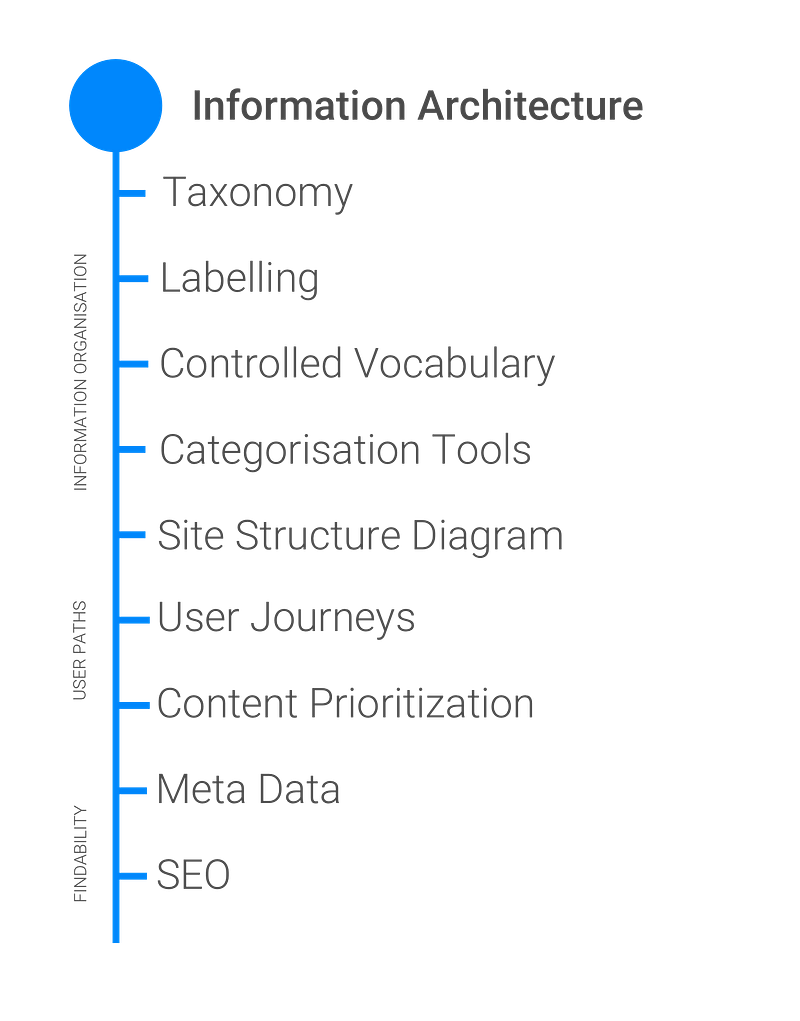
Information Structure | UX Process
Information Architecture
People Involved:
- UX Team ( Information Architect, UX Designer)
- SEO
Process Involved:
Information Organisation
- Taxonomy
Taxonomy is a system for naming (labeling) and organizing things into groups that share similar characteristics. The goal of website taxonomy is to make content easier to find via browsing, searching and asking. A taxonomy should support task completion. Users (humans) as well as technology should be able to correctly interpret a taxonomy.
- Labelling
A label is a word or short phrase that provides an efficient means of summarizing a topic or action. A successful label will often draw on a user’s existing, contextual understanding, their mental model of a topic area or process.
- Controlled Vocabulary
A controlled vocabulary is an organized arrangement of words and phrases used to index content and/or to retrieve content through browsing or searching. It typically includes preferred and variant terms and has a defined scope or describes a specific domain.
- Categorization Tools
Most sets of content can be organized in more than one way. One of the challenges for an IA project is figuring out what way works best for your audience, your content, and your project’s goals. Common content categorization techniques are Alphabetic, Geography, Format, Organizational structure, Task, Audience, Subject/topic and Combined Schemes.
- Site Structure Diagram
A site map (or sitemap) is a list of pages of a web site accessible to crawlers or users. It can be either a document in any form used as a planning tool for Web design or a Web page that lists the pages on a web site, typically organized in hierarchical fashion.
User Paths
- User Journeys
A user journey is a series of steps which represent a scenario in which a user might interact with the thing you are designing. User Journeys demonstrates the way users currently interact or could interact with the service/website / product.
- Content Prioritization
Prioritizing your content is one of the best ways to make sure your visitors are finding the information you want them to find, and that they want to find.
Findability
- Meta Data
Metadata summarizes basic information about data, which can make finding and work with particular instances of data easier. Web pages often include metadata in the form of meta tags. Description and keywords meta tags are commonly used to describe the Web page’s content. Most search engines use this data when adding pages to their search index.
- SEO
Search engine optimization (SEO) is the process of affecting the visibility of a website or a web page in a web search engine’s unpaid results — often referred to as “natural”, “organic”, or “earned” results. User experience’s greatest impact to SEO is through the increase it creates in organic sharing and distribution.
Output:
Structure

Information Structure | UX Process