AWS AI-DLC
EMERGESA prescriptive workflow for the inner loop and its intent interface — strong mechanics, imported theory.
Judgment at human speed. Execution at machine speed.
RATIO 1 : N — ONE REVOLUTION OF JUDGMENT DRIVES MANY OF EXECUTION
Every software methodology of the last twenty-five years was built around one assumption: engineering hours are scarce. That assumption has expired. This is a charter — an audit of the principles, frameworks, and practices our discipline built, conducted against one question: did this exist because humans have judgment, or because human throughput was the bottleneck?
Every entry in the Ledger receives one of four verdicts. ENDURES — rooted in human judgment; AI amplifies it. TRANSFORMS — the purpose survives; the shape changes. DISSOLVES — it managed a scarcity that has ended. EMERGES — no pre-AI ancestor exists.
A prescriptive workflow for the inner loop and its intent interface — strong mechanics, imported theory.
Line-level inspection drowns at machine volume; intent-and-architecture verification is what review becomes.
Status reporting dies — agents report their own status. Judgment synchronisation is what remains.
Problem-framing was always the highest-leverage work; the engine makes it the highest-paid.
Executable definitions of correct — the discipline the whole engine turns on.
Stop prompting agents turn by turn; design the system that runs and grades itself — the writer model is never the one that decides it's done.
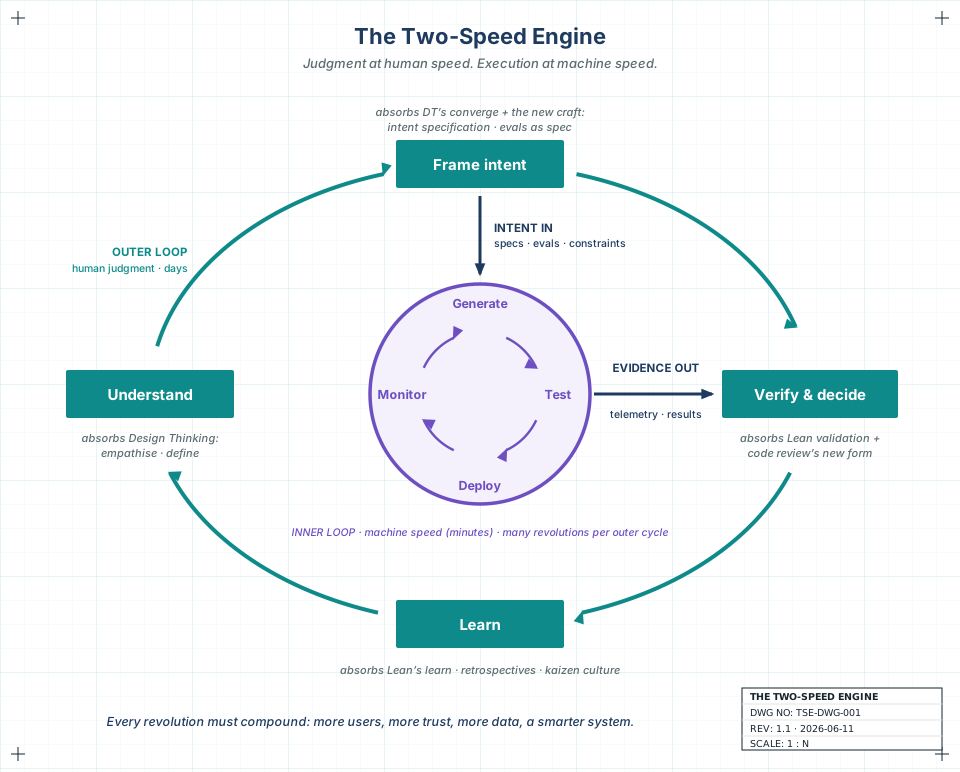
The Two-Speed Engine is a framework by Siddarth Kengadaran that audits the software development lifecycle for the AI era. It models development as one engine with two speeds — an outer loop at human-judgment speed and an inner loop at machine speed — and audits every inherited practice with one of four verdicts: endures, transforms, dissolves, or emerges.
In the Two-Speed Engine, Scrum dissolves — specifically the sprint as a delivery batch. Its machinery existed to coordinate scarce human throughput; when the inner loop produces working software in hours, a two-week batch is a queue in costume. What survives is the inspect-and-adapt instinct and the retrospective. The verdict softens to 'transforms' if a team's sprint boundaries still ration a genuinely scarce resource.
QA does not disappear; the phase dissolves and re-emerges as evaluation engineering. Manual regression QA — re-running scripted checks a machine can run — is what ends. Exploratory and adversarial QA transforms into verification design, and a genuinely new skill appears: trust calibration, knowing empirically where the machines are reliable. Tests stop checking the work and start commissioning it.
The bottleneck moves from routine implementation to integration. As construction cost collapses, the scarce work becomes judgment (what to build and why), specification (intent precise enough that a machine cannot confidently build the wrong thing), verification (output produced faster than anyone can read), and absorbing change into a real system. The chain of Design Thinking, Lean Startup, Agile, and DevOps collapses into one engine with two coupled loops.
Four: judgment (choosing the problem and carrying accountability — torque, not speed), specification (writing intent as the executable gear mesh the inner loop runs against), verification (knowing what to look at, what to sample, and what to let pass), and orchestration (designing the loop that runs and verifies itself, rather than driving it turn by turn).
Specification flips from overhead to the primary artifact — the executable intent the inner loop runs against — but the long upfront PRD as a hand-off document dissolves. Story-point estimation of implementation effort dissolves; estimating total change risk (verification load, migration, rollout, dependency cost) does not. The replacement is bet-sizing against consequence, not the abolition of forecasting.